Blog · · Documentation
Shipper’s Declaration for Dangerous Goods: 7 points to check
Airlines check every Shipper's Declaration against an acceptance checklist. Here are seven points to review before you sign, based on the IATA checklist.
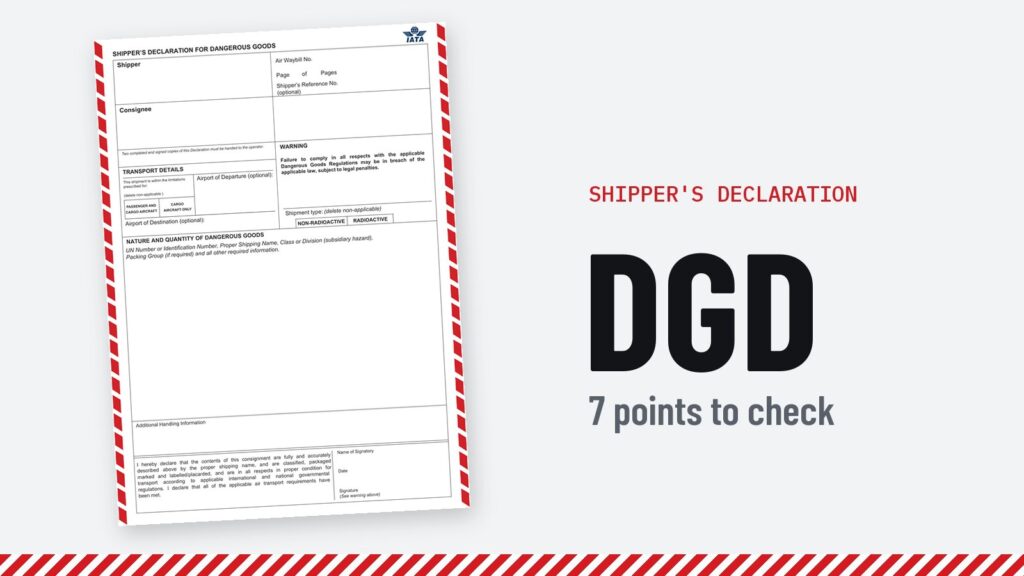
The Shipper’s Declaration for Dangerous Goods (DGD) is the shipper’s statement that the dangerous goods are correctly described, classified, packed, marked and labeled. At acceptance, airline staff compare it with the packages and the air waybill using the IATA Dangerous Goods Checklist. The numbers in square brackets below are the DGR paragraphs the checklist refers to.
1. Format, copies and amendments
The declaration must follow the IATA format, be completed in English, be provided in two copies and include the air certification statement [8.0.2.1, 8.1.1, 8.1.2]. Any amendment or alteration must be signed by the shipper [8.1.2.6].
2. Shipper and consignee
The shipper’s and consignee’s details must be complete [8.1.6.1, 8.1.6.2]. Check them against the air waybill as well.
3. Aircraft type
Of “Passenger and Cargo Aircraft” and “Cargo Aircraft Only”, the one that does not apply must be deleted [8.1.6.5]. If the consignment is for cargo aircraft only, the packages need the Cargo Aircraft Only label.
4. Identification
Enter the UN number with the prefix “UN”, the Proper Shipping Name, the class or division and the packing group [8.1.6.9.1]. These must match Section 14 of the current SDS and the marks and labels on the packages.
5. Quantity and packaging
Show the number and type of packages and the quantity in each package. The quantity must not exceed the per-package limit [8.1.6.9.2].
6. Packing instruction
Show the packing instruction number. For lithium batteries shipped under Section IB, add “IB” to the packing instruction number [8.1.6.9.3].
7. Air waybill
The air waybill must state “Dangerous goods as per associated DGD” [8.2.1(a)] and, for cargo aircraft only consignments, “Cargo Aircraft Only” or “CAO” [8.2.1(b)].


