
Blog · · Lithium batteries
Lithium battery shipments: 5 points to check
UN number, state of charge, the UN 38.3 test summary, damaged batteries and package marks: five points to check before you ship, based on IATA's 2026 lithium battery guidance.
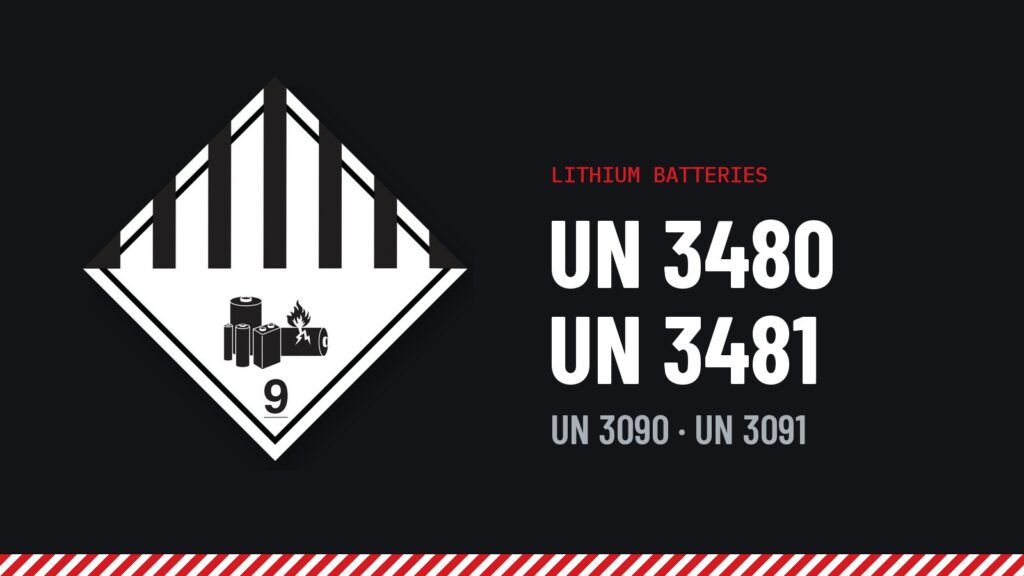
Phones, laptops, power tools and spare batteries: lithium batteries are in many of today’s shipments. The points below are based on the IATA Lithium Battery Guidance Document for 2026.
1. The right UN number
Most lithium battery shipments fall under one of four UN numbers. The battery type (lithium ion or lithium metal) and how it travels with the equipment decide which one applies:
- UN 3480: Lithium ion batteries shipped on their own
- UN 3481: Lithium ion batteries packed with equipment or contained in equipment
- UN 3090: Lithium metal batteries shipped on their own
- UN 3091: Lithium metal batteries packed with equipment or contained in equipment
Before you prepare the declaration, confirm whether the batteries are installed in the equipment, packed with it or shipped on their own.
2. UN 3480 and passenger aircraft
Lithium ion batteries shipped on their own (UN 3480, Packing Instruction 965) are forbidden as cargo on passenger aircraft unless approved under Special Provision A201. They must be shipped at a state of charge (SoC) of no more than 30%, unless Special Provision A331 applies. Packages prepared under Section IA or IB of PI 965 must bear the Cargo Aircraft Only label. The same rules apply to lithium metal batteries shipped on their own (UN 3090, PI 968, Sections IA and IB).
3. The UN 38.3 test summary
Every lithium cell and battery type must pass the tests in subsection 38.3 of the UN Manual of Tests and Criteria. Manufacturers and subsequent distributors must make the test summary available. IATA does not require the summary to travel with every shipment, but some States or airlines may ask for it. Get it from your supplier before you ship.
4. Damaged or defective batteries
Batteries that the manufacturer has identified as defective for safety reasons, and damaged batteries that could produce a dangerous evolution of heat, fire or short circuit, are forbidden for transport by air. This includes batteries in equipment recalled for safety reasons. Check returned or faulty devices for this before you book.
5. Marks and labels
The watt-hour rating or lithium content of the battery and the quantity in the package decide which section of the packing instruction applies. That section in turn decides which marks and labels the package needs. If the watt-hour rating is not printed on the battery, it is the rated capacity in ampere-hours multiplied by the nominal voltage. Check the manufacturer’s data as well.
What to have before you ship
- The current SDS of the product
- Battery type and watt-hour rating or lithium content
- The UN 38.3 test summary
- Number of batteries and weight per package
- Destination country and airline (for State and operator variations)


